Zara Bauer · 9 September 2026
Examining How Structured Data Layers Influence Entity Recognition Patterns in Specialized Knowledge Repositories
Specialized knowledge repositories rely on structured data layers to organize information and support entity recognition systems that identify and connect concepts across large datasets, while researchers in fields ranging from biomedical informatics to legal archives continue to study how these layers shape recognition accuracy and pattern detection over time.
Understanding Structured Data Layers in Knowledge Systems
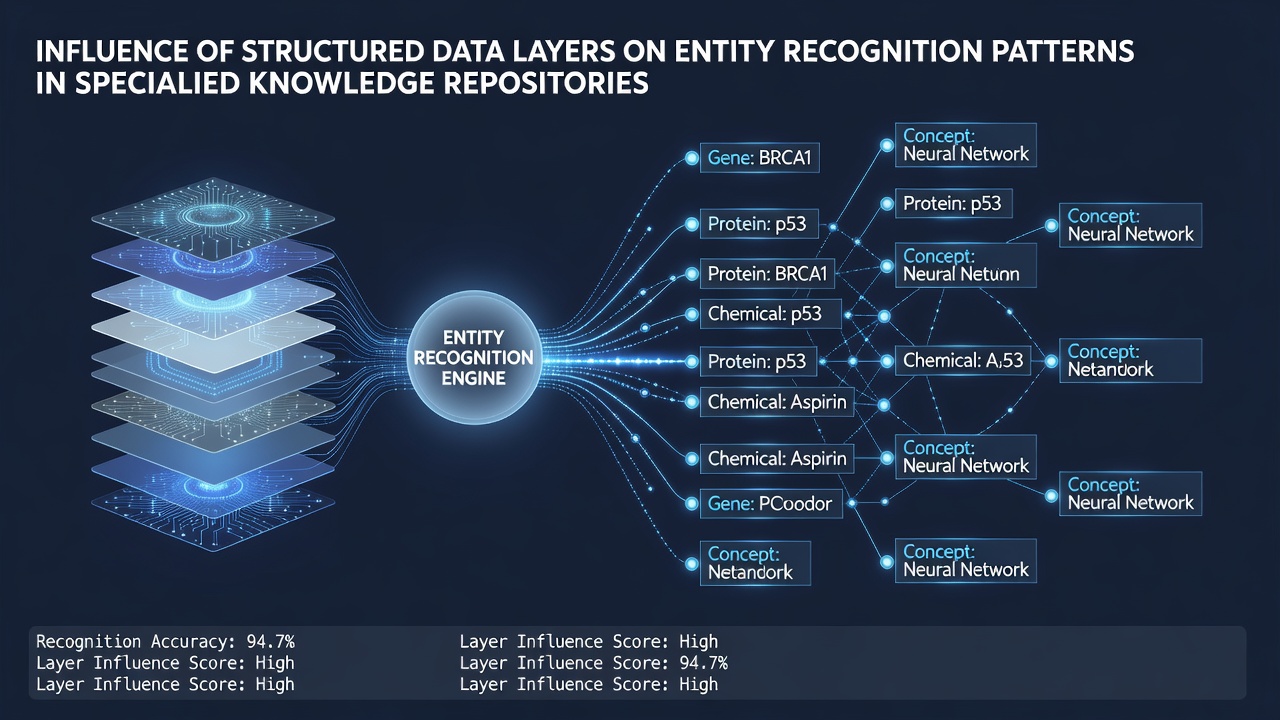
Structured data layers consist of metadata schemas, ontologies, and relational frameworks that sit beneath raw content in repositories, and these components allow algorithms to parse entities such as names, events, and relationships with greater precision than unstructured text alone permits. Data shows that repositories using multiple overlapping layers, including RDF triples and JSON-LD annotations, produce more consistent entity linking results across domains like scientific literature and historical records, whereas single-layer approaches often yield fragmented patterns when queries involve ambiguous terms or cross-referenced sources.
Entity recognition patterns emerge when systems apply these layers sequentially, starting with basic tagging and moving to semantic enrichment that incorporates domain-specific vocabularies, and observers note that this progression reduces false positives in specialized collections where terminology overlaps with general language usage. According to studies on knowledge graph construction, the addition of upper-level ontologies improves disambiguation rates by connecting local entities to broader conceptual networks, which proves especially useful in repositories that aggregate data from multiple institutions.
Mechanisms of Influence on Recognition Patterns
Layered structures influence recognition through hierarchical classification and inference rules that guide machine learning models during training and inference phases, while patterns of entity co-occurrence become more predictable when repositories enforce consistent schema application across entries. Research indicates that systems incorporating temporal and spatial layers alongside core entity data achieve higher recall in identifying evolving concepts, such as updated medical conditions or regulatory changes, because the additional dimensions provide contextual anchors that stabilize matches over successive updates.
One study revealed that repositories employing automated validation against controlled vocabularies experience fewer recognition errors in high-volume query environments, and this holds true whether the focus remains on academic publications or technical documentation archives. Experts have observed that the interaction between data layers and recognition algorithms creates feedback loops where initial entity matches refine subsequent layer applications, leading to iterative improvements in pattern stability without requiring full system retraining.
Applications Across Specialized Domains
In biomedical knowledge bases, structured layers support recognition of gene-disease associations by mapping terms to standardized identifiers, and similar techniques appear in legal repositories where case citations and statutory references gain clarity through layered annotation. Data from European open data initiatives demonstrates that cross-border repositories benefit when layers align with international standards, reducing mismatches that arise from language-specific entity variations. Australian government data portals have incorporated comparable layering methods to enhance search precision in environmental and regulatory collections, showing measurable gains in entity linkage consistency.

What's interesting is how these patterns shift when repositories integrate new data sources mid-cycle, because existing layers must accommodate incoming entities without disrupting established recognition pathways. Researchers discovered that incremental layer updates, rather than wholesale replacements, maintain higher continuity in entity matching across large-scale collections, and this approach has gained traction in projects scheduled for broader deployment around September 2026.
Recent Developments and Measurement Approaches
Measurement of layer influence typically involves precision-recall metrics applied to test sets drawn from repository subsets, and figures reveal that multi-layer configurations often outperform baseline models by margins that vary according to domain complexity. Academic sources, including analyses from Canadian research networks, highlight the role of provenance layers in tracing entity origins, which in turn strengthens recognition when conflicting data appears from different contributors.
Repositories that publish their layer specifications openly allow external systems to align more readily, creating network effects that amplify recognition accuracy across connected platforms. Yet the process demands ongoing maintenance to prevent schema drift, and those who've studied long-term deployments note that governance protocols play a central part in sustaining pattern reliability.
Conclusion
Structured data layers continue to shape entity recognition patterns by providing the organizational scaffolding that algorithms depend on for accurate identification and linkage within specialized knowledge repositories. Evidence from multiple regions shows that thoughtful layer design correlates with improved consistency, and ongoing work through 2026 is expected to refine these interactions further as new standards and integration methods emerge.